Research
Many everyday materials, from coatings and adhesives to the resins used in 3D printing, are crosslinked polymer networks: long molecules joined into a single three-dimensional structure. How that network is built decides both how easily the material can be processed and how it performs afterwards. My research asks how the molecular architecture of crosslinked and dynamic polymer networks can be designed, and measured reliably enough, that processability and final properties are set together at the synthesis stage.
I see this as the organic (macro)molecular chemistry of materials, seen through the eyes of rheology. My particular contribution is the tailored synthesis of reactive oligomers with specific architectures and functionalities, by routes that can be scaled up; rheology then shows how those molecules behave once they become a material. I combine organic synthesis, rheology and design of experiments, in collaboration with groups in Modena, Bologna, Ghent and other institutions. The examples below show results already published; the current work section describes what is still in progress.
Selected results
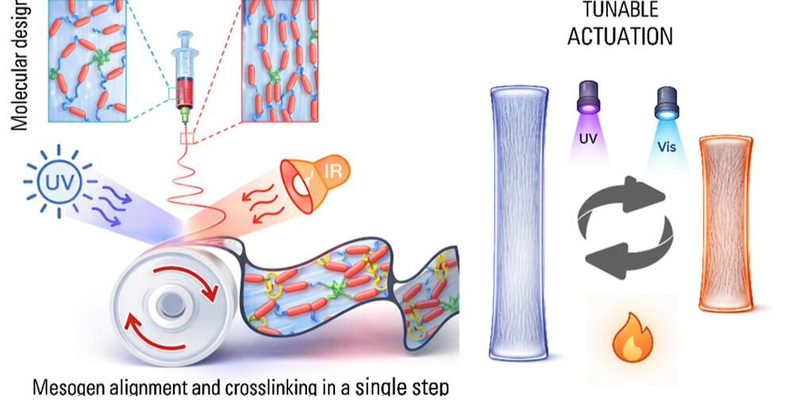
Liquid-crystal elastomer actuators made in a single processing step
Question. Liquid-crystal elastomers (LCEs) change shape when heated or illuminated, but only if their rod-like mesogens are aligned. Alignment usually requires a separate stretching or templating step after synthesis, which limits how these materials can be produced.
Approach. We designed acrylate-terminated liquid-crystalline oligomers (by thia-Michael addition) and combined electrospinning with in-flight photocuring, so that the fibres are aligned and crosslinked in the same step. Design of experiments was used to optimise the coupled process.
Finding. The electrospun LCE mats actuate in response to heat and to light without a post-synthesis stretching step. Varying the oligomer chain length revealed a maximum in actuation performance, where the effects of photocuring rate and crosslink density on the network work in opposite directions.
Contribution. First author; work carried out at the University of Bologna within the PRIN 2022 project ALICE.
Paper. N. Braidi et al., ACS Appl. Mater. Interfaces 2026, 18, 39385 (doi, open access).
Star polymers as crosslinkers with a tunable network density
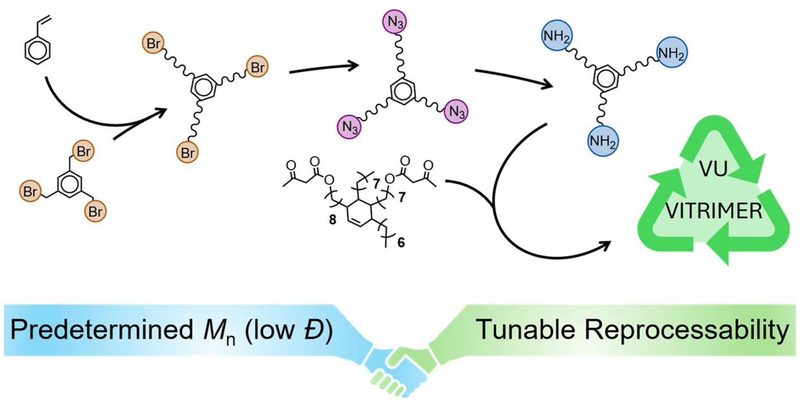
Question. Crosslink density controls swelling, glass transition and, in dynamic networks, reprocessability. Can a well-defined macromolecular crosslinker set it in a predictable way?
Approach. Star-shaped polystyrene with three arms was grown by ARGET atom transfer radical polymerization (ATRP) from a trifunctional initiator, then converted to a triamine (azidation followed by Staudinger reduction). The triamines were used to cure a conventional epoxy resin and to form vinylogous urethane vitrimers, a class of covalent adaptable networks.
Finding. The stars were obtained with low dispersity (Đ < 1.2) and molar masses between about 2 and 12 kDa, on a scale of tens of grams. Changing the molar mass of the crosslinker tuned the crosslink density, and with it the swelling, the glass transition temperature and, in the vitrimers, the reprocessability.
Contribution. First author; work carried out partly during a research stay at Ghent University (group of Prof. F. E. Du Prez).
Paper. N. Braidi et al., Polym. Chem. 2025, 16, 1546 (doi).
Gels without a crosslinker in ARGET ATRP of styrene
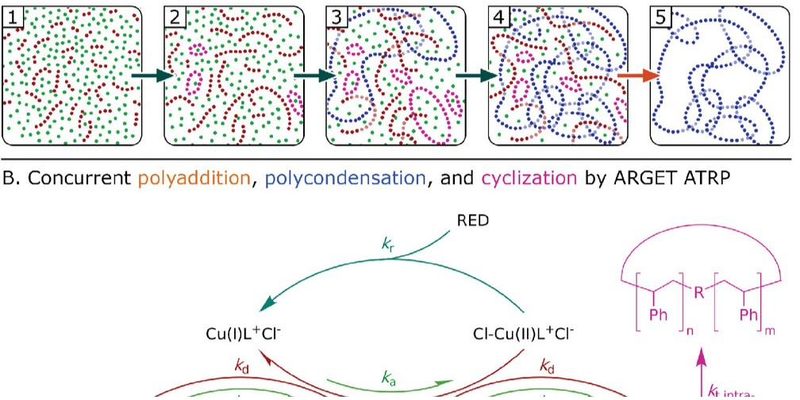
Question. ARGET ATRP of styrene from a bifunctional initiator unexpectedly produced crosslinked polystyrene although no crosslinking agent was present. Where do the network junctions come from?
Approach. Polymerization kinetics were measured at different temperatures and ethanol fractions. A kinetic model based on the method of moments, which accounts for the formation of polymer rings, was fitted to these data and then used to simulate the effect of catalyst, initiator and reducing agent.
Finding. In the model, conditions that favour ring formation also favour gelation. This supports, rather than proves, the hypothesis that these networks are Olympic gels, held together by interlocked rings rather than by covalent crosslinks.
Contribution. First author of the observation (2021) and of the kinetic study (2025), from my doctoral work at UNIMORE.
Papers. N. Braidi et al., Macromol. Res. 2021, 29, 280 (doi); N. Braidi et al., Macromol. Rapid Commun. 2025, 46, 2400564 (doi).
Current work
These projects are in progress; results will be added here when published.
- Recyclable epoxy networks from biorenewable building blocks. β-hydroxyester networks (Departmental Research Fund 2025, sole proposer) and β-amino amide curing agents for epoxy resins, the latter as a student thesis project.
- Polymer-brush silica nanoparticles for solid polymer electrolytes, as a student thesis project.
- Lignin-derived resins for photocuring, with UNIMORE colleagues and external partners: bisguaiacol-based coatings and vat 3D printing resins (Prog. Org. Coat. 2026; Polym. Chem. 2026).
- Measurement protocols for dynamic networks: checking sample stability and thermal history before interpreting stress relaxation (see the Practical Note).
Direction for the next years
The results above share one thread: the network architecture, which is set during synthesis, determines what can be done with the material later. Over the next years I intend to pursue three connected aims:
- Reliable characterisation of dynamic networks — protocols that separate bond exchange from degradation, post-curing and other changes in the sample (underway).
- Macromolecular and bio-based building blocks for recyclable thermosets — crosslinkers and curing agents whose structure sets crosslink density and reprocessability (underway).
- Processing-aware formulation — combining rheology and design of experiments so that processing behaviour and final properties are optimised together, for example in photocuring (proposed next).
Discuss the research
Students interested in a thesis on these topics can find how to enquire on the Teaching page. Researchers and companies are welcome to get in touch; the Industrial Collaboration page explains how a collaboration with a company is set up. A full list of papers is on Publications, and the techniques I use are listed in the CV.